Everybody is claiming to be AI-native these days, but nobody quite seems to agree on what it means. In this essay, I’ll try to bring a little clarity to this debate, informed by my own lived experience.
Instead of throwing yet another definition into the mix, let’s focus on the word itself. We say native as if its meaning were obvious. But let’s slow down and ask what we normally mean by it. And also, let’s not jump straight to digital-native or mobile-native, which is where this conversation always seems to rush off to. Let’s go further back than that.
Think about what it means to be native to a language, or to a country. Take someone who grew up speaking French and set them beside someone who learned it later, as a second or third language. Even when the latecomer has the vocabulary and grammar down cold, there’s often a whole layer underneath that they still don’t have. These are the things the native absorbed without ever noticing, beliefs and assumptions buried so deep they couldn’t explain them to you if you asked. You see the same thing in any deep skill. A great tennis player can’t really tell you how the serve works, they just do it. That tacit layer, the part that never makes it into words, is where being native actually lives.
And here’s the part to remember, because the whole argument depends on it. Usually, a native is someone who grew up with the thing. But not always, and that exception is the key. You can get there as an adult too, the way people reach real fluency in a language: not by studying it from the outside, but by going and living inside it.
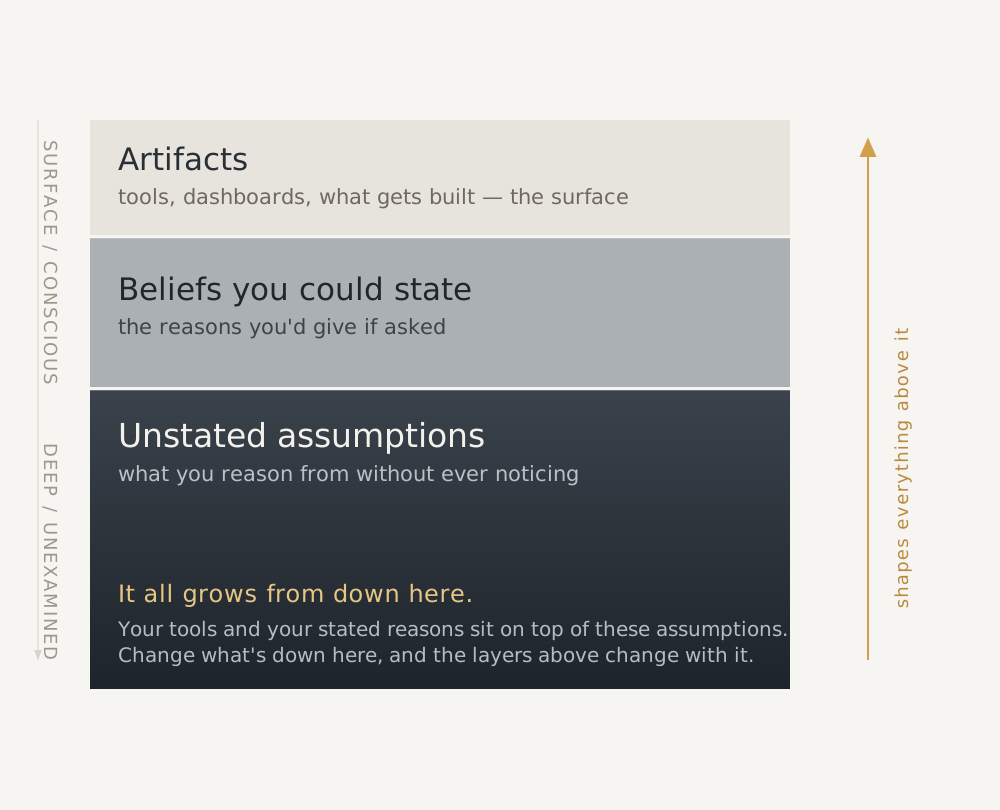
Figure 1: Your tools and your stated reasons sit on top of the assumptions you never examine; change what’s underneath, and the layers above change with it.
We’ve called things “native” before
Now let’s carry that back to technology, because this is exactly what we intuitively mean by the earlier “native” waves. A company that grew up after the internet was ubiquitous simply doesn’t see the world the way a company retrofitting itself onto the internet does. It isn’t that one has better tools. It’s that it reasons from a different set of assumptions, most of them never said out loud.
And none of this is new. It’s an old observation — Edgar Schein on the layers of a culture, Argyris and Schön on the theories we actually operate by, a long line of cognitive-psychology work on how experts and novices look at the same problem and see different things. The real shifts have never happened at the surface, where the visible artifacts are. They happen down in the assumptions. Jeff Bezos is a clean example. He looked at the business of selling books and questioned the one thing nobody in that business thought to question — that you needed a store at all. Well, did you?
So are you doomed if you weren’t born into it?
Which lands us on the question that actually matters to most of us, because almost nobody reading this was born into the AI age. If you weren’t, are you simply out of luck?
I don’t think so, and again, the language analogy is the way in. We don’t tell adults they can never become fluent in a second tongue. They can. The whole question is how. The way that mostly fails is the textbook way, where you sit outside the language and translate it back into the one you already think in, dragging your old habits and intuitions along. The way that works is immersion. You drop into the middle of it and flail around until you find your feet. There’s no gentle on-ramp, and that’s the point. Immersion forces what the Zen tradition calls beginner’s mind. You have to set down most of what you were sure you knew before anything new can get in.
What it actually looked like for me
So how do you get to a beginner’s mind when you’ve spent a whole career building the opposite reflex? I can only really speak from one case, my own, so take it for whatever an N of one is worth.
I’ve been doing AI and data-science work for a long time. I was writing papers on AI last decade, back when “AI” meant something rather different. That kind of work drills into you the habit of thinking the whole thing through in advance; you trace out every branch of the logic and write it into the code, because the code won’t run otherwise. The agents we had built and deployed at my company, Eisengard, a few years back were like that. The user’s path was mapped ahead of time (if they ask this, do that; if that, then this), and the LLMs got called in at certain points to look something up or answer a question inside the rails I’d already laid down. Even once the more autonomous agents showed up and started getting good, I caught myself asking the old question about them, “okay, where in the logical flow does this thing slot in?” I had a new tool in my hands and I was still holding it with the old mind.
Then last year we hit a crunch point. The team was stretched thin on a live client, on tight timelines that didn’t bend, and the next version of the agent still had to get built, and it fell to me to build it. So I had no real choice but to go at it differently. That part, the crisis, was just bad luck. It didn’t teach me much per se, other than to shove me into an immersion I’d never have chosen on my own. You don’t need a crisis for that. You can walk in on purpose. It’s just that in my case, it was triggered by the crisis.
Going AI-native, it turned out, meant throwing out most of what I was sure I knew. The actual principles of logic and data science still hold, but I had to discard the deeper assumptions — that I had to be the one driving everything, that I had to have thought everything through before the machine did anything. I had to learn to trust it. You go in with something close to a blank mind and you drink from the firehose. I more or less lived in Claude Code, in Cursor, in whatever had gotten good that year. And somewhere in there I caught myself thinking in a genuinely different way. The AI had stopped being a part I was slotting into a workflow and started being something I was thinking with, close to what Ethan Mollick means by co-intelligence. My own job drifted upward, away from the line-by-line coding and toward the steering, and the auditing, and the real battle-testing.
What came out on the other side honestly surprised me. I built an agent that beat the far more elaborate one we had shipped before, and it took days rather than months. But not because the AI did it on its own. Ask it cold and what comes back is useless. You have to steer the whole way, and you have to know enough to tell the difference between what’s working and what’s quietly broken. The leverage was not in the tool. It was in a different way of working it.
And to be clear, a good deal of what I’ve just described is what people now call vibe coding. In addition to the agent, I went on to build, in a few weeks, a whole backlog of features we’d thought would take multiple quarters to get through. Fine. But you can’t vibe-code something mission-critical without serious discipline around it, and even when it works it’s still engineering. The required features were already defined for me, and I was doing the same job, only faster. That’s not the leap.
The leap, and the turn back
The leap was somewhere else, and it came later. After a few months of living inside this — fingers on the keyboard, really breathing a different way of working — the new way of thinking didn’t stay politely inside the code. I’m a strategist by training and a CEO by job, and you can’t switch those off. So the same loose, fluid, questioning way of thinking I’d been applying to the build started wandering into the assumptions of the business itself. It started small and tactical, and then grew to become strategic. Why is a sprint two weeks? What actually belongs inside one? What are we even calling “quality,” and how should that be measured? And it kept widening — to the product, to the customers, to who the “users” really are, all the way to what we were actually in the business of.
You end up looking at the old way of doing things a little like a child who grew up with AI might look at it, watching people grind through something by hand, rule by rule, and asking the question: “why are you doing it like that?”
So I turned back around and looked at the things we had always just filed under “the cost of doing business”, the buried assumptions nobody thinks to poke at. The business side and the data side of a company speak different languages; everyone knows this, and so for decades the whole industry has papered over the gap the same way, throwing consultants and meetings at it, with somehow no one ever quite owning the data. It was simply how things were done. Native fluency asks the question, “Does it have to be that way? And why, exactly?”
What came out of that was a system that I built myself, before handing it to the team for client deployment. I won’t walk through the internals, but the overall pattern of it is the part worth seeing. Instead of bolting an AI assistant on top of the old consulting-like workflow, it turns the conversation itself into the product. The knowledge, the assumptions, the structure of the problem — the stuff that used to live in slide decks and in people’s heads — gets drawn out and made explicit in the course of an ordinary conversation with the agent, with transparency and accountability sitting where the politics and the hand-waving used to be. And it quietly rewrites who does what, what a “data person” actually does, what a “business person” is expected to bring, where the client’s own people sit in the loop. Here’s the part I keep coming back to, though. The moves that turned out to matter most weren’t on any plan I’d drawn up. I didn’t reason my way to them. They surfaced on their own, out of the immersion, and there’s no way that by just thinking harder at the whiteboard a year earlier, I would’ve gotten to them. That isn’t a footnote to the story. To me it’s the center of it.
And the limits of this approach are very real too, and this is where the builder in me has to hand off to the strategist. Seeing the thing was the beginning, not the end. A reframe in my own head doesn’t move a client an inch, their people are exactly where they were yesterday. And a working system still has to be carried into their world and made to survive there, which is its own genuinely hard problem. I can build the thing; it takes the team to make it hold up once it meets reality. Keep that in mind, because it comes back at the end.
A method, not a fluke
You might say this is just a story about one person getting lucky with a new tool. There’s luck in it, yes, but only at the two ends. Luck shoved me in, and I’ve already said you don’t need that part. You can walk in on purpose. And luck drove what the immersion turned up, because you can’t command what you’ll end up seeing. That part really is an unbounded search. But between those two ends sits the thing that’s neither luck nor mine — the immersion itself, which you choose and you repeat. That’s the method. It’s old, far older than me, and it shows up again and again once you start looking for it.
The crux is that you can’t reason your way into these sharply different reframings of the problem from the outside. You are searching in an infinite idea space. If you proceed step-by-step with logic, you tend to stay in your local space (although there are some tricks you could use to reach farther out, like using analogies). As history tends to show, sharp breaks don’t usually happen in such a methodical, continuous fashion. However, after the fact, the armchair quarterbacks turn up to explain that it was obvious all along and they would have seen it in a heartbeat. But nobody was seeing it until that first person did. It looks perfectly obvious looking back; but going in, you’re hunting for something and you don’t even know yet what it is.
Spelled out, the method is this — you immerse yourself in some new world until it quietly rewires what you take for granted, and then you turn back to the old problem and find you can suddenly see it in a new light, and the solution quickly pops out. This is the recurring pattern, and the clearest examples are far bigger than anything I did. After his initial decades in Wall Street, Charlie Merrill, co-founder of Merrill Lynch, left all that behind and spent years running a grocery-supermarket business and growing that into a big success (Safeway Stores). And when he came back to Wall Street to rescue his crisis-stricken old firm, he looked at the thing everyone there simply assumed to be true, that ordinary middle-class people had no business buying stocks, and saw it as a choice rather than a law of nature, and built the whole financial-supermarket idea by challenging that assumption. (I’ve written about Merrill in my academic work, and I’m certainly not the first to notice the pattern in him.) Also note that Merrill was able to see the old problem in a new light, but he still had to exercise considerable judgment and his formidable skills to translate that into an industry-defining strategy.
Galileo did a version of the same thing to astronomy. He mastered the telescope (he didn’t invent it) and really lived in it, grinding his own lenses, until he turned it on a very old question and the perfect, unchanging heavens quietly came apart. The same pattern turns up in military history too, in the rethinking of what the tank was for in 1940. These are the pattern at its grandest; what I described earlier is a small, recent instance of the same method. The scale is wildly different. The method is the same.
I want to be very clear on one point though. This method, of immersing yourself into a new domain and then revisiting the old, changes what you’re able to see, and only that. It doesn’t make you right, and it doesn’t make you a winner. The difference between someone who’s gone AI-native and someone merely bolting AI onto what they already do, or someone trying hard to understand it while still carrying the old system around in their head, is a difference in what they can see. It is not a verdict on who comes out ahead.
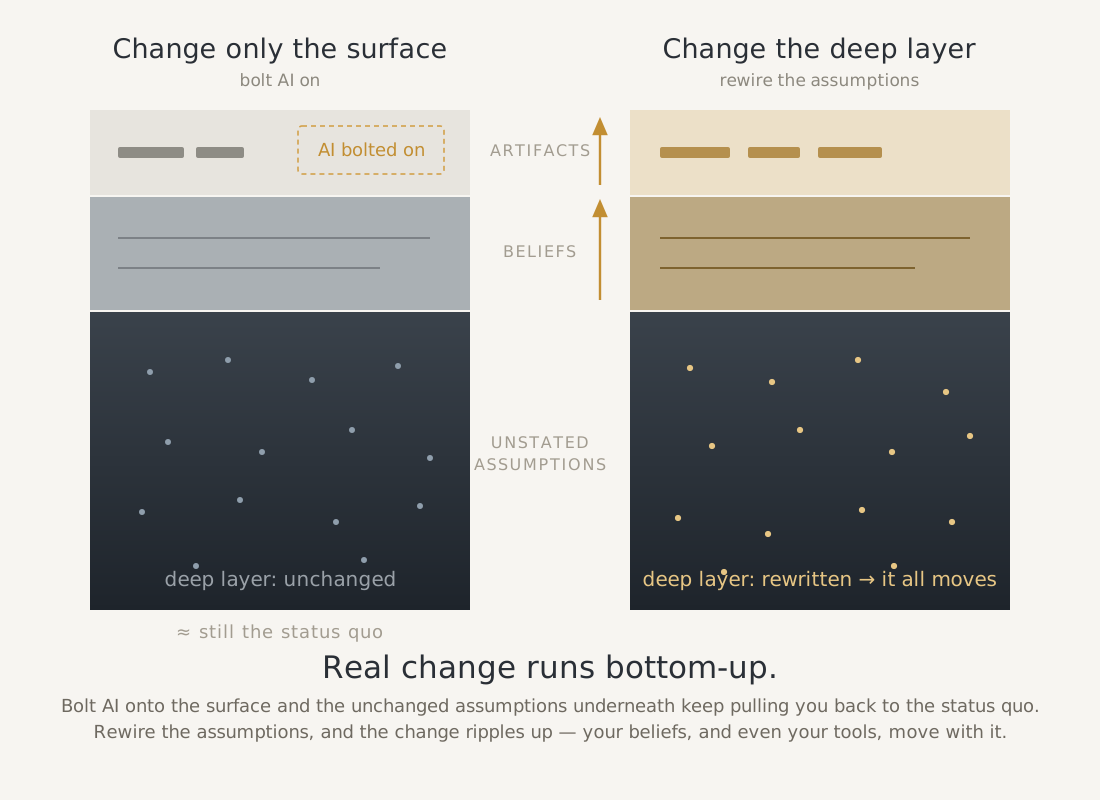
Figure 2: Two kinds of change. Bolt AI onto the surface and the unchanged assumptions keep pulling you back to the status quo; rewrite the assumptions, and the change ripples up through your beliefs, and even your tools.
Where this sits next to everyone else
So where does this line of thinking fit in the larger discussion on the meaning of AI-native?
There’s a test that’s been making the rounds, introduced by CRV. Take the AI out, and does the product still work? It’s a good test, and I would call it a necessary condition. But it’s not a sufficient condition. You can pass it cleanly (build something that genuinely fails without the AI) and still be running the whole operation on conventional assumptions, with the AI wired into an old theory of what the business even is. Pull the AI out of someone who’s truly AI-native and they look like a fish out of water. But that dependence is a symptom of the thing, not the thing.
The venture community is also correct in that all this generates new business models, many of them moving toward Service-as-Software. Marco Iansiti and Karim Lakhani are right that it rebuilds the firm’s operating model, the “AI factory” humming away under the modern company. Ethan Mollick is right that you have to get your hands dirty and treat the AI as a kind of colleague. I’m not disagreeing with any of them. I’m simply pointing out the floor underneath all of it. The new business models, the operating model rebuilt around the AI factory, those are all real, and they’re what changes. But they’re downstream. What moves first, and what makes everything after it possible, is the way the person sees. When you’re native to something, the world simply looks different to you, and the rest follows from there.
Where it goes
We’re early in the AI revolution, and forecasting is often a way to embarrass yourself later, but some rough patterns are already visible. As the models keep getting stronger, the people who are already AI-native go further in, and the ones who aren’t stay with assumptions they’ve never examined. The gap between them widens. After a while, what an AI-native can see starts to look to everyone else like some mix of luck and magic.
But seeing isn’t winning, and I don’t want to leave the wrong impression. The new ideas need to be implemented successfully, and that means they need to interface with the beliefs and assumptions of others. The ripple out from a real reframing is slow, and sometimes it never arrives at all. The first person to see a thing can still lose. The AI Pin was a confident bet on a reframing the market simply declined to follow. And a perfectly correct insight can die inside an organization that can’t move with it. Kodak’s leadership saw the digital future about as clearly as anyone and still couldn’t drag the company over to it. Going AI-native can change what you can see. Whether the world will move with you is a separate problem, call it the coordination problem, and it’s mostly not one you get to solve by yourself.
However, if you run the clock far enough forward, I believe the term will quietly eat itself. As more of what’s implicit gets dragged into the open and made explicit, more of what people now settle in meetings will get handed off to the agents themselves to work out. As the models continue to get more powerful, and as more and more people immerse themselves in the new technology and reframe their deep assumptions, AI-native ideas that we currently cannot even imagine will probably start being executed successfully. And at some point, asking whether someone is “AI-native” will sound about as strange as asking whether they’re “electricity-native” sounds today, not because it stopped mattering, but because by then it’s simply true of everyone, a label that fits everyone and that has stopped telling you anything.
The limited claim
I’ve tried to keep this to what I can actually defend from where I stand, namely, one phenomenon I lived through, and a pattern that seems to recur well beyond me. There’s a deeper argument underneath this one — about what happens to a firm, and to its strategy, when the assumptions it was built on suddenly shift, as they are doing now. That’s the work I’m taking up at length in longer papers and a book, built out of my earlier work on strategy and cognition. This essay is just the near edge of it.
To me, being AI-native was never about how much AI you’ve bought, or how much you’ve bolted on. It’s whether the thing has quietly rewritten the assumptions you reason from, so that you turn back to the old problem and, at last, see it differently.